
By B. Rich Kwik
People often ask me what the secret to success is.
There isn’t one.
There are seventy three.
The difference between successful people and everyone else isn’t intelligence, luck or talent. It’s stacking tiny, scientifically optimised micro habits until your entire existence becomes an elaborate hostage situation.
My morning routine has been assembled after interviewing hundreds of billionaires, Olympic athletes, Navy SEALs, monks, CEOs, venture capitalists and one exceptionally productive golden retriever.
I don’t always complete every step. Especially when travelling.
Sometimes I only do sixty.
The important thing is intentionality.
Win the morning and you win the day.
Win enough days and eventually somebody lets you host a podcast.
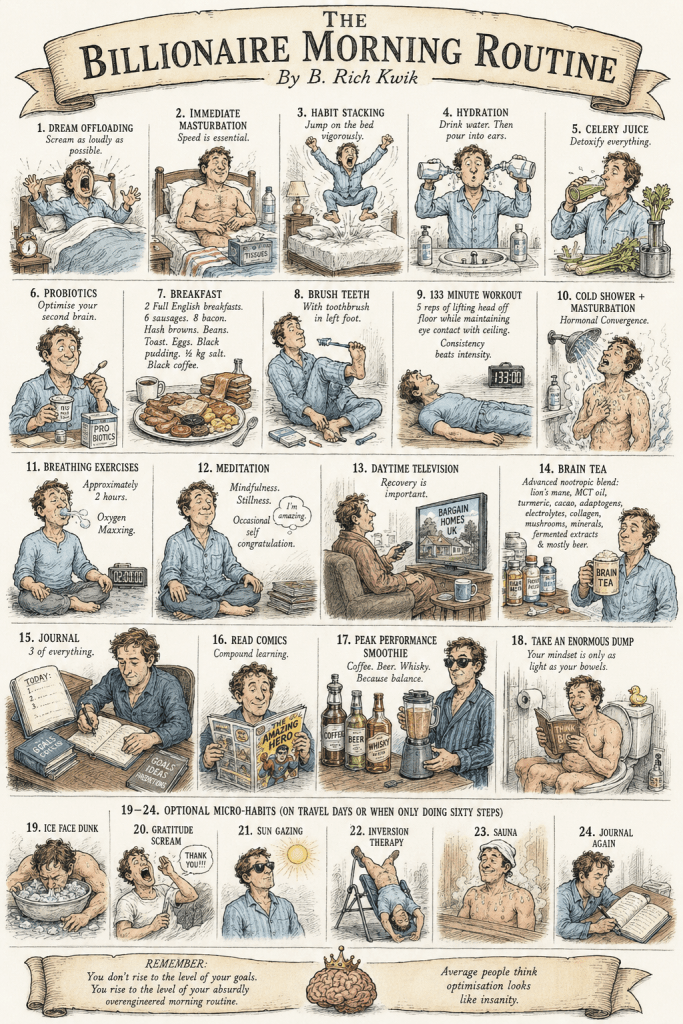
The very first thing I do, before opening my eyes, is scream.
Not metaphorically.
As loudly as I possibly can.
I call this Dream Offloading.
Most people allow their subconscious to clutter the brain with unnecessary emotional residue from dreams. I expel mine immediately with a primal scream lasting between twelve and forty five seconds.
Many history changing breakthroughs came from dreams.
Mary Shelley dreamt Frankenstein.
Paul McCartney dreamt Yesterday.
Einstein reportedly visualised relativity while asleep.
Coincidence?
None of these geniuses ever claimed not to have started the day screaming.
The evidence speaks for itself.
Once I’ve completely evacuated my subconscious, I immediately masturbate.
Speed is essential.
Morning physiology means peak efficiency can often be achieved with almost no cognitive overhead, allowing me to bank a quick dopamine dividend before breakfast.
I keep a dedicated performance towel beside the bed.
Successful people prepare the night before.
Unsuccessful people call it “just a towel.”
Immediately afterwards I climb back onto the bed and jump vigorously on the mattress.
This is called Habit Stacking.
I’ve already screamed.
I’ve already achieved orgasm.
Now I’ve already exercised.
Three wins before sunrise.
That’s momentum.
Next comes hydration.
Your brain is approximately seventy five percent water.
Most people make the mistake of only drinking it.
I drink one large glass, then carefully pour another into each ear so my brain remains lubricated from both sides.
I can’t prove this works.
Science simply hasn’t caught up yet.
Then I drink celery juice.
Anthony William, the Medical Medium, says it detoxifies the liver, restores the adrenal glands and improves almost everything.
Critics point out that he receives medical advice from a ghost.
I choose to keep an open mind.
My probiotics come next because your gut is your second brain.
It’s important to optimise both brains before breakfast.
Breakfast itself is deliberately light.
Two full English breakfasts.
Six sausages.
Eight rashers of bacon.
Hash browns.
Beans.
Toast.
Eggs.
Black pudding.
Half a kilo of salt.
And a black coffee because balance is important.
After eating I brush my teeth using a toothbrush held in my left foot.
This forces my brain into neuroplastic adaptation.
Could I simply use my hand?
Yes.
Would that create a compelling LinkedIn post?
No.
Next comes my famous 133 minute workout.
People assume this is intense.
It’s actually five repetitions of lifting my head off the floor while maintaining complete eye contact with the ceiling.
Consistency beats intensity.
Always.
Then it’s time for a cold shower.
Most people stop there.
That’s why they’ll never become exceptional.
Cold exposure combined with simultaneous masturbation creates what I call Hormonal Convergence.
I made that term up.
But it sounds expensive enough to be true.
By now my nervous system has been reset, my hormones optimised, my subconscious emptied, my neurochemistry upgraded and my towel is in desperate need of attention.
Next I perform breathing exercises.
These take approximately two hours.
I call the technique Oxygen Maxxing.
The goal is to inhale more oxygen than anybody else.
Afterwards I meditate using the revolutionary three step system of mindfulness, stillness and occasional self congratulation.
Then I watch daytime television until one o’clock.
Recovery is just as important as performance.
My Brain Tea follows.
It’s an advanced nootropic blend containing lion’s mane, MCT oil, turmeric, cacao, adaptogens, electrolytes, collagen peptides, trace minerals, fermented mushroom extracts and, for taste, mostly beer.
Finally I sit down to journal.
Every day I write down three professional goals.
Three personal goals.
Three things I’m grateful for.
Three affirmations.
Three business ideas.
Three startup names.
Three cryptocurrency predictions.
Three reasons everyone else is wasting their lives.
Then I reward myself by reading comics for thirty minutes.
Reading one comic a week keeps me intellectually agile.
Never underestimate compound learning.
To finish, I blend coffee, beer and whisky into what I call a Peak Performance Smoothie.
People often tell me this routine seems excessive.
I understand.
Average people always think optimisation looks like insanity.
Remember:
You don’t rise to the level of your goals.
You rise to the level of your absurdly overengineered morning routine.
Also, don’t forget to take an enormous dump.
Your mindset is only as light as your bowels.
 Stories to Read...