There are two kinds of journeys: the ones that get you somewhere, and the ones that briefly take you somewhere else.
Stories to Read exists for the second kind.
This site will publish free, weekly short stories – humorous, slightly odd, occasionally touching – written to fit into the gaps of modern life. They are stories for waiting rooms, coffee queues, missed connections, delayed departures, and yes, trains. Especially trains.
Our first collection is Stories to Read on the Train, a series of tales carefully calibrated to the rhythm of rail travel. Short enough to finish between stations. Long enough to make you forget where you are for a moment. Designed to be read while someone nearby sighs loudly, rustles a pastry wrapper, or explains their life story into a phone on loudspeaker.
Some of these stories may cause a quiet chuckle. If so, please don’t panic. Simply pretend you’ve received an amusing text, or glance meaningfully at the window as though you’ve remembered something pleasant about your childhood.
For readers travelling between London and Brighton on the non-express service, these stories have been arranged – through no real scientific process -to fill the precise gaps between stations, assuming the reading speed of an average small adult. Your results may vary if you skim, reread sentences unnecessarily, or become distracted by tunnels.
New stories will arrive weekly. They’re free. All you need to do is subscribe, and they’ll appear in your inbox like a polite companion who knows when to stop talking.
All aboard.
The book has been delayed due to leaves on the track.
I adjusted my posture into what I call Professional Compassion Mode™ just as my 11:00 a.m. client entered the room carrying the emotional energy of a man recently betrayed by both history and stationery.
He sat down slowly.
Very slowly.
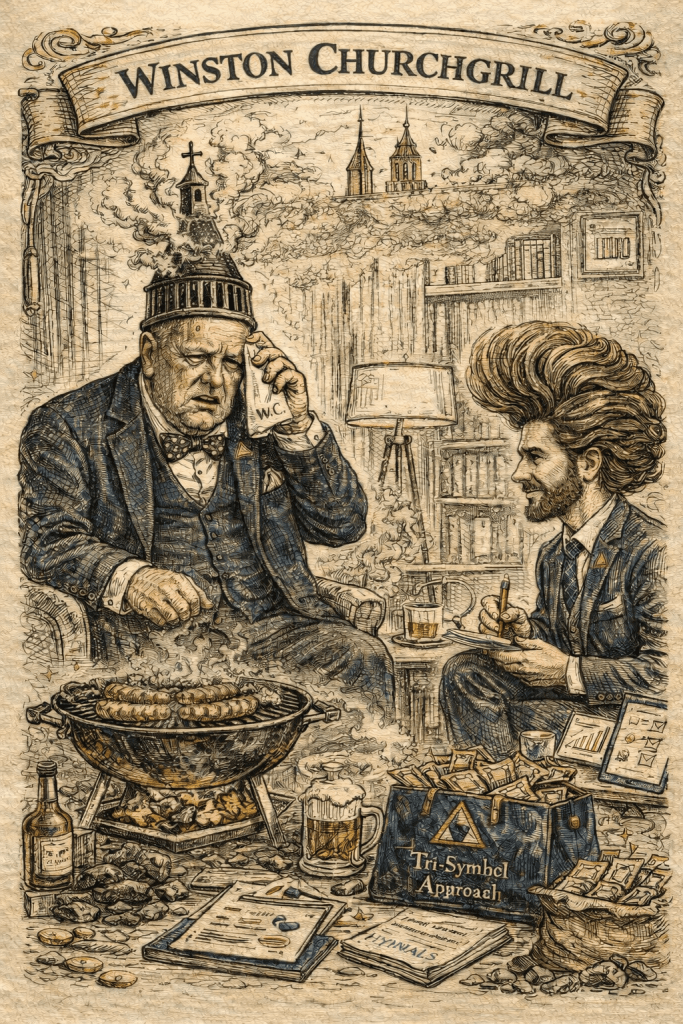
“I’m Winston Churchgrill,” he said.
I nodded calmly, though internally my soul attempted to resign.
“Welcome, Winston,” I said. “What brings you here today?”
He stared at the carpet as though searching for alternate parents beneath it.
“My life,” he said, “was sabotaged at birth.”
A powerful opening. Rarely do clients arrive already summarising their trauma.
“They named me Winston,” he continued. “Do you understand what that means in this country?”
I offered a neutral coaching expression—the face of someone emotionally available yet legally non-committal.
“I cannot introduce myself without someone narrowing their eyes,” he said. “People expect courage. Strategy. Speeches during national crisis.”
He wiped his forehead.
The sweating had begun early.
“I ordered a flat white yesterday,” he said. “The barista said, ‘We shall fight them on the beaches,’ and upgraded me to oat milk out of respect.”
“That sounds difficult,” I said gently.
“My manager keeps asking for morale speeches,” Winston continued. “I clean algae from tropical fish tanks. Nobody needs wartime rhetoric near a clownfish.”
He shifted in his chair. A visible sheen now covered his brow.
“But Winston,” I asked softly, “is the first name the main source of distress?”
He inhaled sharply.
“No,” he whispered. “It’s Churchgrill.”
He loosened his collar.
“I want you to really think about this,” he said, leaning forward. “A grill. At a church.”
A bead of sweat rolled down his temple.
“Have you ever attended Sunday service and smelled charcoal?” he demanded. “Has a priest ever said, ‘Let us pray… and also rotate the sausages’?”
I hesitated. “Not to my knowledge.”
“Exactly!” he cried. “There are church bells, church pews, church halls—but grills? Never! My surname implies centuries of clergy hosting barbecues!”
His breathing quickened.
“I researched my ancestry,” he continued. “Nothing. No sacred cookouts. No medieval brisket ministry. Just confusion.”
Sweat now formed with strategic ambition.
“People ask if my family catered the Reformation,” he said. “Someone asked whether Lent is just slow-roasting season.”
I noted acute nominative distress.
“So how does this make you feel?” I asked.
He stared at his trembling hands.
“I don’t know who I am,” he said. “Am I a statesman? Am I catering staff? Am I ecclesiastical cookware?”
At this point perspiration achieved full participation.
“I wake up at night imagining bishops arguing over propane,” he whispered. “Sometimes I dream of hymns accompanied by sizzling.”
Powerful vulnerability.
I leaned forward.
“Winston,” I said, “names do not define destiny.”
He blinked through sweat.
“You are not bound by historical expectation or hypothetical priest barbecues.”
He sat silently, absorbing this revelation while dabbing his forehead with what appeared to be an emergency handkerchief labelled W.C.
“So what should I do?” he asked.
“Reframe the narrative,” I said.
The following week he returned transformed.
Radiant. Confident. Only mildly damp.
“It worked,” he announced.
“That’s wonderful.”
“Yes,” he said proudly. “I told everyone to call me Win.”
I smiled.
He hesitated.
“…Unfortunately,” he said, “they now call me Win the Grill.”
 Stories to Read...