


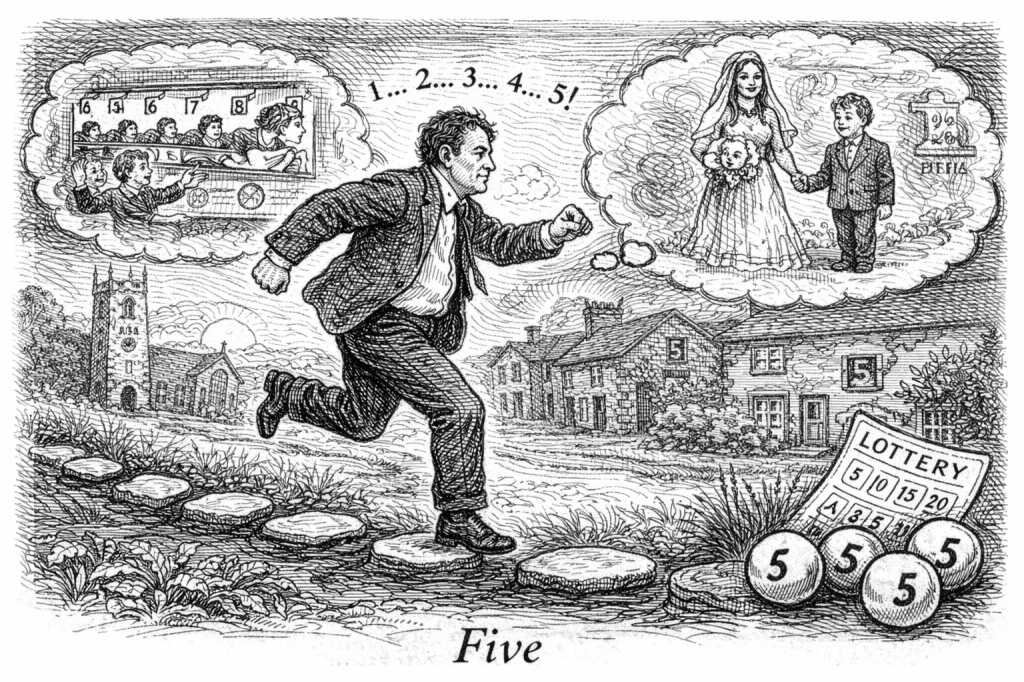
If you happen to live in the village of Greenham in Yorkshire, and have ever taken a morning walk along the village trail at 5 a.m., you may have noticed a gentleman in his mid-fifties hopping along in great single strides, landing on every fifth stone. In that case, you will have come across Mr Paul Barclay.
Paul Barclay has one small issue which has both blighted and blessed most of his 55 years: the number five. He won a small fortune – a pound – at the age of five while on holiday with his family in the local arcades. It was a horse race game in which you choose a number and wooden horses run down a track inside a glass case. The joy of winning was ecstatic. He felt his life was complete, that no success could better it.
As a child, he adopted five as his mascot, making sure he had five of everything. His fifth birthday was momentous and, as he grew older, he vowed to follow his dreams using this number as his guide. Some people see a favourite number as lucky, but for Paul it dictated everything.
He was determined to leave school with five A levels, which he did, but it was from here that his problems started. He was offered a place at a top university in London but turned it down because he felt that the fifth university on the list would be far more suitable. Hence, he studied at a low-ranked university that at least afforded him the opportunity to become an accountant. He worked in a variety of firms throughout his career and was now at his fifth accountancy firm, which he planned to stay with until retirement.
He was married to his fourth wife, Beth, with whom he had four children, and this was causing Paul considerable concern. He did not know whether to have a fifth child with Beth, knowing that child would become the apple of his eye, or to find a fifth wife, knowing she would be the “Special One”. His wife knew of Paul’s numerical obsession but did not for one minute think it would affect his family life.
Paul was regarded as an eccentric at work, though colleagues only vaguely understood his issues. At his interview, as he entered the room, he was faced with a panel of three people and five empty chairs. Paul chose to sit in the fifth chair, even though it meant facing a wall. This was clearly impractical, so to compensate he got up every five minutes and walked around the room five times. He got the job because he asked five more questions than the panel asked him, which demonstrated keenness and enthusiasm.
With the security of a job, Paul and his wife set about looking for a house in the local area, which proved tremendously difficult because he would only consider a property with the number five. Eventually, they found one, but it was a small, pokey one-bedroom flat at 5 Market Street, with no garden. Paul had to work hard to convince his wife that this was the ideal place to set up home and raise a family. He promised her that if the five-bedroom house at 55 Manor Gardens ever became available, they would move.
Life was far from easy, and with a growing family in a one-bed flat, it soon became intolerable.
Their bank account, however, was growing, and eventually 55 Manor Gardens came onto the market for four hundred and sixty thousand pounds. Paul Barclay sealed the deal by offering five hundred thousand. He was delighted, but Beth had to find a job to keep up with the payments.
Paul’s hours were steady, but he became an increasingly isolated figure. He was always in the office as people arrived, but greeted only the fifth person to enter. He was warm and cordial with that individual alone and would not speak to, or even acknowledge, the others. Unsurprisingly, Paul Barclay was not popular. All his meetings were arranged for fifty-five minutes past the hour, and he always left the office at 5 p.m.
But this, he felt, was to be his year. Since turning 55, he believed the stars were on his side. He had just bought his fifth car and was looking forward to his fifth family holiday of the year, though his wife was thoroughly fed up with travelling. He hoped to add five more bedrooms to the house, convinced it would bring them greater security, even though he did not have the funds to pay for it. For his wife’s birthday, he bought her a puppy to add to the four dogs they already owned. His numerical obsession was now firmly entrenched and beginning to dominate his life.
Paul Barclay did love his fourth wife and believed she was the one, but when he asked her for a divorce, she was devastated, especially as it came entirely out of the blue. She questioned her abilities as a wife and mother and fell into a depression. She still loved Paul and pleaded with him to reconsider, particularly when he insisted there was no one else.
One evening after dinner, he produced a document prepared by his solicitor outlining the details and date of the divorce. He wanted everything handled correctly and amicably. Reluctantly, Beth agreed to the morning of the fifth day of the fifth month. She broke down in tears, confused and betrayed.
Paul then asked her to keep the afternoon free for 5 p.m.
“But why?” she asked.
“So that I can make you my fifth wife,” came his delighted reply.
The wedding required meticulous planning, as Paul insisted on spending exactly five thousand pounds, not a penny more, not a penny less. He was now on a roll and immediately began trying for his fifth child, despite their finances spiralling out of control.
One evening, they sat down to review their financial situation. It was clear something had to change. Aside from their mortgage, they had accumulated forty thousand pounds in credit card debt. Paul, however, saw opportunity. He began booking more holidays and even purchased another car. He believed that if he could increase his debt to fifty thousand pounds, the power of five would guarantee him a lottery win. He was convinced that five million pounds was just around the corner. It reminded him of that childhood moment when the horse bearing the number five had surged across the finish line.
With this in mind, he reduced his working hours to five per day. His wife was at her wits’ end. His colleagues, too, were increasingly bewildered by his obsessive behaviour. Once he began speaking to someone, he felt compelled to continue for exactly five minutes, even if the question required only a simple one-word answer. In meetings, he distributed papers to the first five people he saw and ignored the rest. On one occasion, he insisted on sitting in the fifth chair he encountered, which happened to be reserved for the CEO. He refused to move, creating a deeply awkward situation, particularly as the company was hosting international clients.
He remained at the head of the table, forcing the CEO to sit further down, and proceeded to run the meeting, insisting on breaks every five minutes.
Remarkably, Paul negotiated a contract worth ten million pounds down to five million. He thanked the five people directly in front of him, ignored the CEO entirely, and dismissed everyone at 5 p.m. His boss was furious and demanded a meeting. Paul, however, was unconcerned. He was certain he would win the lottery that very day.
On his way home, he bought a lottery ticket, selecting the number five and its multiples. He took the number five bus, despite having five cars at home, and arrived to find a default notice from the bank for non-payment of the mortgage. His wife was in tears; eviction was imminent. He was also facing dismissal the next morning.
None of it mattered.
He once again thought back to the horse race, the number five surging ahead. It was destiny. That evening’s prize was five million pounds.
He greeted his wife with the customary five kisses and made five cups of tea. It brought him comfort, certainty, even. He reassured her that everything would be fine. After a dinner consisting of five courses, they sat down to watch the lottery results. After switching the television on and off five times, just to ensure luck, they began checking the numbers.
The first five matched.
They were elated.
Then the sixth number was called.
Paul read it aloud.
Beth turned to him slowly.
“You’ve only picked five numbers!”
The win amounted to only a few pounds.
Paul Barclay lost his job the following day. His wife and children were forced to leave the house, along with the five dogs, and he moved into a hostel with four other residents. In room number five, he lives to this day, working on Route Five as a refuse collector.
He sees his children five times a year.
And his wife filed for divorce on the fifth of May, their anniversary.


Leave a Reply