


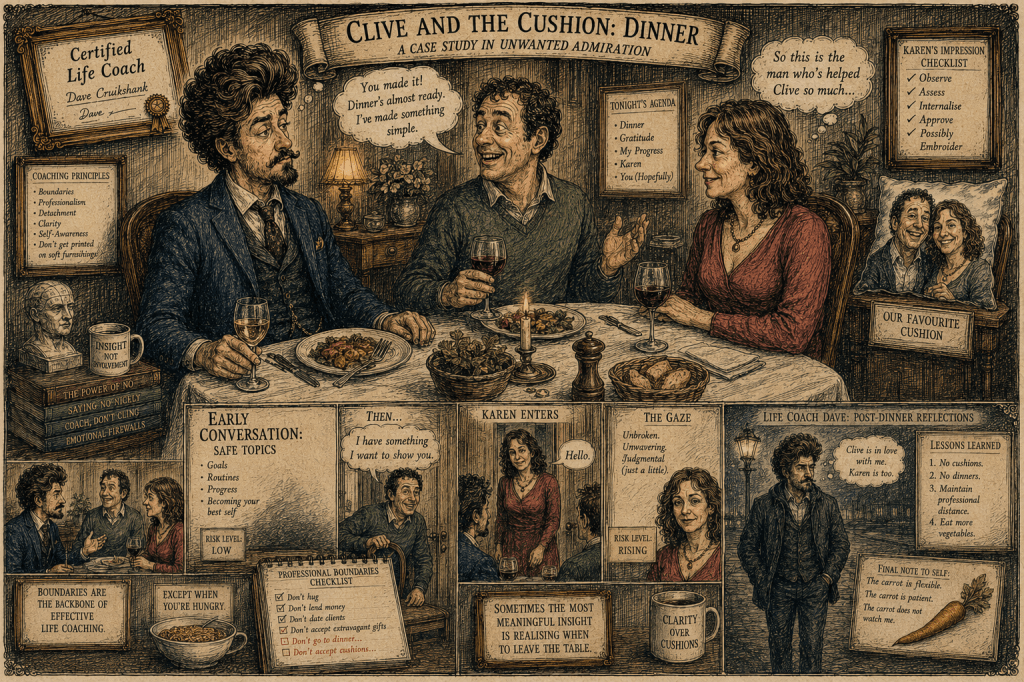
I have always maintained that boundaries are the backbone of effective life coaching.
I have also, on occasion, eaten instant noodles three nights in a row and described it as “intentional minimalism.”
So when Clive emailed to invite me to dinner—“Nothing fancy, just a small thank-you”—I knew, professionally, that I should decline.
Then I opened my fridge.
Inside was a lemon, a jar of something that used to be pesto, and a single carrot that had achieved a level of flexibility I did not think botanically possible.
I replied, “That sounds lovely.”
Clive’s house was in a quiet street that suggested stability, home ownership, and coordinated bathroom towels. He greeted me at the door with the same enthusiasm he’d shown in session, which is to say: too much, but sincerely.
“You made it!” he said, as though I’d crossed an ocean rather than taken a moderately delayed train.
“Of course,” I said, stepping inside. “Thank you for having me.”
There are moments where you realise, immediately, that you have made a mistake. This was not one of those moments.
Not yet.
The house was immaculate. Not clean—immaculate. The kind of clean where objects seem to have agreed, collectively, not to exist unless strictly necessary. The air smelled faintly of citrus and quiet expectations.
“Can I take your coat?” Clive asked.
“Yes, thank you.”
He hung it with great care, smoothing the sleeve as though it might be judged later.
“Dinner’s almost ready,” he said. “I’ve made something simple.”
This, I would later learn, was a lie.
We sat. We ate. The food was, annoyingly, excellent. Perfectly cooked, well-seasoned, plated with the kind of confidence that suggests Clive had watched at least twelve hours of cooking tutorials and taken notes.
“This is really good,” I admitted.
Clive beamed. “I wanted it to be special.”
“Special” is a word that, in my line of work, has range.
For the first twenty minutes, everything was… normal. We discussed goals. Progress. The importance of routine. At one point, Clive asked if I thought he was “becoming his best self,” and I said something affirming but non-committal, which is my professional brand.
And then, without warning, Clive placed his fork down.
“I have something I want to show you,” he said.
Ah.
There it was.
The moment.
“I think you’ll recognise her,” he added.
Her.
I felt a small, internal shift. A memory surfaced. Satin-finish fabric. A necklace that judged.
Clive stood, smoothing his shirt, and turned toward a closed door at the end of the room.
“Karen?” he called, softly. “You can come in now.”
There was a pause.
The door opened.
And there she was.
Karen.
In person, she was exactly as advertised. The same smile—though now it moved, which was somehow more unsettling. The same necklace, resting with quiet authority at her collarbone.
“Yes,” I said, before Clive could ask. “I recognise her.”
Clive looked delighted. “From the cushion!”
“From the cushion,” I confirmed.
Karen walked toward the table with a kind of deliberate grace, her eyes fixed on me. Not in a casual, socially acceptable way. No—this was focus. Attention. The sort of unwavering gaze usually reserved for fine art or approaching weather systems.
“Hello,” she said.
“Hello,” I replied.
She sat.
Across from me.
Still looking.
There are different types of silence. Comfortable silence. Reflective silence. This was neither. This was a silence that had weight. Density. It pressed gently against the sides of the room.
“So,” Clive said, a little too brightly, “what do you think?”
Of Karen?
Of the situation?
Of my life choices?
“She’s… exactly as I expected,” I said carefully.
Karen smiled. It was the same smile from the cushion. I had not realised, until that moment, that it could be sustained indefinitely.
We resumed eating.
Or rather, Clive and I resumed eating. Karen continued to look at me as though I were explaining something fascinating, despite the fact that I had not spoken.
“Karen was very excited to meet you,” Clive said.
“I can tell,” I said.
“She’s heard so much about you.”
This did not surprise me. What concerned me was the tone: proud, reverent, as though he had been describing not a life coach, but a minor deity with strong opinions about scheduling.
At one point, I reached for my glass of water. Karen’s eyes followed the movement with precise, unbroken attention.
I drank.
She watched.
I placed the glass down.
She watched that too.
“Everything okay?” I asked, eventually.
“Perfect,” Karen said.
Clive nodded enthusiastically. “Perfect.”
Another silence.
I became aware, gradually, of a pattern. When I spoke, both of them leaned in—subtly, but unmistakably. When I paused, they waited. Not politely. Expectantly.
As though I might continue.
As though I should continue.
“I think,” I said, choosing my words with care, “that it’s important to maintain… balance. In all relationships.”
Clive nodded, deeply moved. Karen’s gaze intensified, which I had not thought possible.
“Yes,” Clive said softly. “Balance.”
Karen did not speak. She did not need to. Her expression suggested that whatever I said next would be received, preserved, and possibly embroidered onto soft furnishings.
And that’s when it settled, quietly but firmly, into place:
Clive was in love with me.
Karen was also, unmistakably, in love with me.
Not romantically, perhaps. Not in any conventional sense. But with a kind of focused admiration that made me feel less like a person and more like a concept. A very well-organised concept.
I finished my meal.
I thanked them.
I left.
On the walk home, I reflected on the evening, on boundaries, on the delicate architecture of professional relationships.
When I got back, I opened my fridge.
The carrot was still there.
Flexible. Patient. Uncomplicated.
I ate it.
And I made a second note for my practice:
No cushions.
No dinners.


Leave a Reply