Families in the UK love a day out at the zoo. It is a place to educate children about the importance of looking after the environment, and especially the animals that inhabit it.
The relationship between humans and animals is vital to this cause. Besides, it’s nice to spend a few hours amusing ourselves at the antics of our inferior cousins.
Yes, it’s enjoyable to spend a few hours marvelling at the wild and weird creatures with whom we share this great green earth.
*
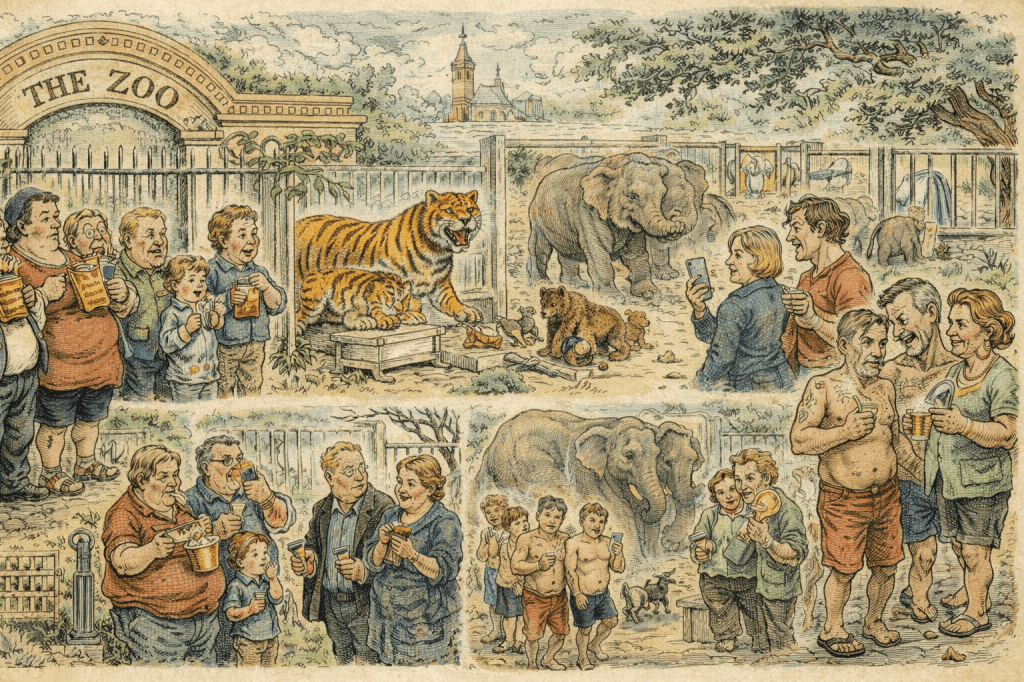
We visit first the big cat enclosure, where the tigers are waiting to be fed, and so are the Baldock family: Pauline and Barry and their three children, Charlie, Harry and Mel.
The whole family is overweight. Barry and Pauline smoke sixty cigarettes a day between them, and the children have an excessive craving for sugar.
We join them at the tiger enclosure, where the keeper is planning to give a brief talk at feeding time.
“Good afternoon, ladies and gentlemen. The tigers are roaming around as they are hungry now and becoming impatient. Food is motivating them.”
Young Charlie blurts out.
“Mum, I want an ice cream!”
“Shut your mouth. You’re still eating that burger. Stop eating for the sake of it.”
The keeper continues her talk.
“Tigers are quite lazy animals and will only hunt when they are hungry and need to eat. They do not kill and eat for the sake of it.”
Charlie pipes up again.
“Dad. I want another burger.”
Harry has overeaten and now feels sick, while Mel munches through a bar of chocolate.
“Mummy, what’s for dinner?”
“Can’t you shut it? You’re always eating,” Mum replies, while chomping on crisps.
The keeper begins dangling the meat towards the lions.
“Look at how lean and healthy these beautiful species are.”
Twenty-stone Barry moves nearer and lights up a cigarette. He drools slightly at the joint of meat.
“Can I have chips with that, love?”
The keeper ignores him and explains that cats can carry more than twice their weight.
Pauline opens another bag of crisps.
“But tigers will only eat as much as they need, leaving some until later.”
“I want another burger,” Charlie wails from the back.
Barry waddles back to his family.
“And they can run at speeds of thirty miles an hour.”
The children stuff their mouths with food, attempting to talk over one another.
Pauline steps in.
“Don’t bloody talk with your mouth full.”
The keeper continues feeding the tigers.
“Notice how they chew the food slowly, not eating more until they have swallowed the last bit.”
Finally, she mentions how the tigers purr in an almost harmonious way.
Barry and Pauline tell the children:
“Stop fuckin’ complaining and eat up. Let’s grab a hot dog.”
*
Over at the bird section, Maureen and Cyril, who have been married for half a century, watch avidly as the exotic Patagonian parrots chatter to each other.
It is explained to the group that, for these birds, communication is vital as they are partners for life and look out for each other.
Maureen looks over to Cyril, who grunts.
They do not talk.
“The Patagonian parrots chatter to each other all day and seem even to laugh at times. To them, this is their entertainment.”
Cyril, looking morose, glances over at Maureen, who too looks morose.
In front of them the parrots continue chattering.
She wants to take some photos, so gestures to Cyril with a clicking motion for him to pass the camera.
Cyril nods.
They do not speak.
The parrots become very animated and squawk loudly while perched next to each other.
Their language is obvious.
The keeper, smiling at the small crowd, explains the commotion.
“This noise is communication between the two. It can express anxiety or appreciation, but either way it continues throughout the day, constant calling while staying close to one another.”
Maureen passes the camera to Cyril, who nods and gestures that they should go.
They walk separately down the path.
The parrots squawk in the background.
*
The bear enclosure is always busy with people fascinated by their behaviour.
A mother bear nurtures and protects her young cubs and does not take her eyes off them.
A group of adults stand engrossed in their phones, oblivious to the fact that their children are drifting away without their knowledge.
They look up from their screens as the mother bear growls loudly when one of her cubs strays slightly from the group.
The adults smile and continue scrolling as their own boy ventures further away from his parents, who remain absorbed in their phones.
The mother bear anxiously gathers her cubs and walks with them through the enclosure, nudging any that drift back into line.
The young child is now wandering aimlessly through the zoo.
His parents chuckle at pictures on their phones.
The bear keeper explains:
“Bears are particularly protective of their cubs and, if necessary, will kill any predators that come near them.”
The parents nod and continue texting.
The child is now lost and begins crying in the crowd.
“Bears know at all times where their cubs are and never let them out of their sight.”
The parents begin taking separate calls.
“Bears do not allow cubs to fend for themselves until they are much older.”
The parents laugh into their phones.
The child is eventually picked up by one of the zoo attendants.
*
Over at the penguin enclosure, the keeper is cleaning out the tank. She speaks to a group of overseas tourists who marvel at the uniformity of the penguins.
“They all have the same mannerisms as they walk, but they are graceful, shy, and each has its own character.”
At this moment a group of shirtless young men with matching tattoos approaches the enclosure, swaggering loudly and displaying a remarkable uniformity of character.
The penguins busy themselves to the amusement of the tourists, while one of the men calls out:
“If you were covered in chocolate we’d eat you – you know, like those Penguin chocolate bars. It’s a joke, innit?”
The keeper continues.
“Penguins are stocky and short-legged and breed every three years.”
The loudest of the group, who happens also to be stocky and short-legged, shouts back:
“Breeding every three years would be no good for me.”
The others laugh loudly and raucously as the penguins shy away.
As the men catch their reflections in the glass, smoothing their hair and bare chests, the keeper explains to the tourists:
“Penguins preen themselves for hours each day to keep the feathers on their skin properly oiled so that they don’t freeze to death. It is for survival, not vanity.”
In the corner, one of the men admires his reflection.
“Not bad if I say it myself.”
“Penguins can drink salt water if they need to,” the keeper adds, “but generally stay hydrated from the food they eat.”
At this point the group leave to the chant:
“We want a pint! We want a pint! That’s how we stay hydrated.”
*
Before we leave, at the elephant compound, a herd led by the matriarch ambles slowly through the enclosure, occasionally chomping on grass.
The keeper explains:
“The females are generally the herd leaders, and the others in the group follow behind.”
At that moment we see Maureen approaching the enclosure with Cyril a few metres behind her.
They do not talk.
“The elephants take the lead from the matriarch and are almost deferential to her.”
Maureen turns and gestures impatiently to Cyril, who speeds up.
“Elephants are herbivores and eat a wide variety of plant foods.”
Barry and Pauline arrive with the children, moving with a gait not entirely unlike the elephants. The family munches on hot dogs.
“Elephants look after their young for a long time before letting them venture into the world. They are extremely caring and protective.”
The parents of the lost boy arrive nearby, playing games on their phones. They do not realise their son is missing.
“Elephants use their long trunks to find water for hydration.”
The group of young men appear again, noses buried in plastic beakers of beer, slurping loudly.
*
As the day closes and the sun sets, our visitors leave the animals to their enclosures and return to their cars.
The zoo gates shut behind them.
Inside, the animals settle down for the evening.
Outside, civilisation continues.
 Stories to Read...