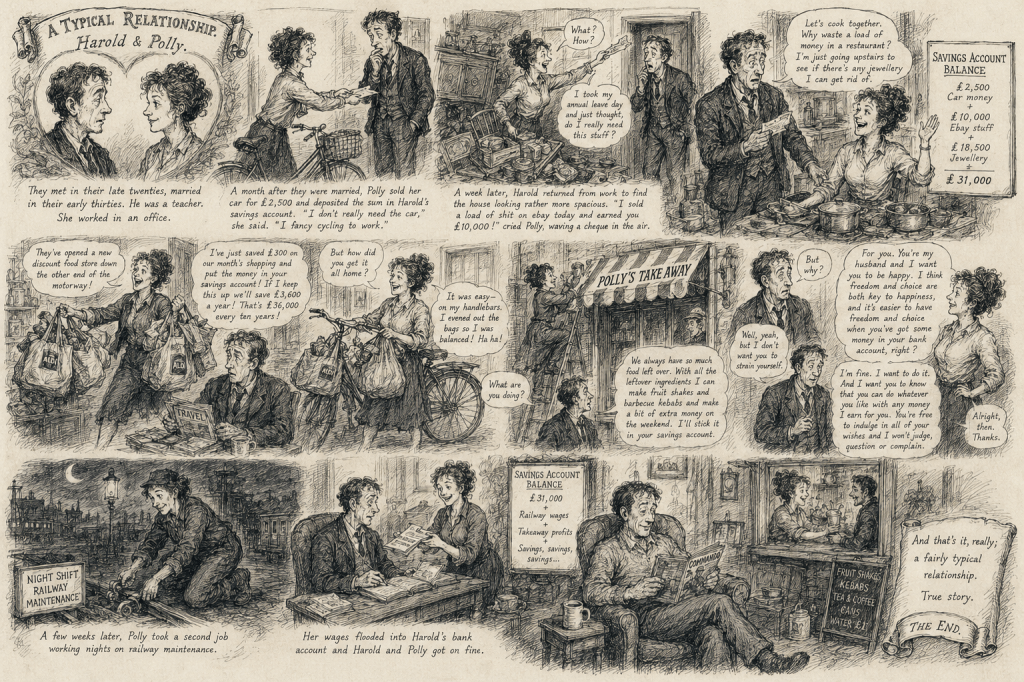
Their relationship was fairly typical. They met when both in their late twenties, married in their early thirties. He was a teacher. She worked in an office. Harold and Polly.
A month after they were married, Polly sold her car for £2,500 pounds, and deposited the sum in Harold’s savings account, which until then had been empty. She said she didn’t really need the car, and quite fancied cycling to and from work each day.
A week later, Harold returned from work to find the house looking rather more spacious. The antique furniture Polly had brought with her when she moved in was gone, as was her extensive shoe collection, and most of the clothes from her wardrobe. For a moment, Harold was worried, but then Polly returned home waving a cheque in the air, saying: “I sold a load of shit on ebay today and earned you £10,000.”
“What? How?” Harold asked, as Polly shoved the check into his hands.
“I took my annual leave day and just thought, do I really need this stuff? You can deposit that in your savings account.”
Harold looked at the cheque in his hand. Ten thousand pounds.
“Well, at least let me take you out to dinner,” he said.
“No, no, no,” laughed Polly. “Why waste a load of money in a restaurant? Let’s cook together. It’ll be more fun! I’m just going to pop upstairs to see if there’s any jewellery I can get rid of.”
*
A week later, Harold was at home looking through some travel brochures. He’d deposited the £10,000 in his savings account, plus the £18,500 Polly had got for selling her jewellery. He was thinking about treating Polly and himself to a holiday, but Polly was an hour late returning from work and he was getting worried.
Then she suddenly burst through the door carrying a load of Aldi bags.
“They’ve opened a new discount food store down the other end of the motorway,” cried Polly. “I’ve just saved £300 on our month’s shopping and put the money in your savings account! If I keep this up we’ll save £3,600 a year! That’s £36,000 every ten years!”
“But how did you get it all home?” asked Harold.
“It was easy – on my handlebars. I evened out the bags so I was balanced! Ha ha!”
*
A few weeks later, Polly converted the front of their house into a take away food outlet.
“What are you doing?” asked Harold, as Polly, perched on a step ladder, hung a red and white canopy outside the front of their kitchen window.
“We always have so much food left over,” said Polly. “With all the leftover ingredients I can make fruit shakes and barbeque kebabs and make a bit of extra money on the weekend. I’ll stick it in your savings account.”
“But why?” asked Harold.
Polly looked at him, puzzled. “For you,” she explained, stepping down from the ladder. “You’re my husband and I want you to be happy. I think freedom and choice are both key to happiness, and it’s easier to have freedom and choice when you’ve got some money in your bank account, right?”
“Well, yeah, but I don’t want you to strain yourself.”
“I’m fine. I want to do it,” said Polly. “And I want you to know that you can do whatever you like with any money I earn for you. You’re free to indulge in all of your wishes and I won’t judge, question or complain.”
“Alright, then,” said Harold. “Thanks.”
A few weeks later, Polly took a second job working nights on railway maintenance. Her wages flooded into Harold’s bank account and Harold and Polly got on fine.
And that’s it, really; a fairly typical relationship.
True story.
The End
 Stories to Read...