Clive was different. Unlike my other clients, it was abundantly clear within the first few minutes of our session that he’d already passed the point of hope and had taken up permanent residence somewhere beyond it. Not despair, exactly. Something flatter. Like a field that had been over-farmed and politely given up.
There was an emptiness behind his eyes – the sort that makes you lean in, waiting, dreading, knowing it must be something heavy. He fiddled with his hands. Stared at nothing in particular. Paused long enough that I briefly wondered if he’d fallen asleep.
And then he spoke.
“It’s the stamps,” he said.
I nodded, as if stamps were something people often came to therapy for. I waited for the rest of it – the metaphor, the punchline, the reveal that stamps stood in for something else. A dead parent. A lost marriage. A childhood home sold to developers.
But no.
It was stamps.
Clive took me back to 2005. A year he described with the soft reverence usually reserved for childhood summers. Low-rise jeans. American Idol. Harry Potter and the Goblet of Fire. A world that, according to Clive, had quietly disappeared while nobody was watching.
“First-class stamps were thirty-two pence,” he said.
He worked at his local Tesco then, earning £8.85 an hour. One hour’s work bought him twenty-eight stamps. He had done the maths recently, carefully, with the kind of precision normally applied to grief.
“Twenty-eight,” he repeated, almost fondly.
Clive loved stamps. Not in a sexual way, obviously. He wasn’t one of those collectors with magnifying glasses and white gloves. He loved their design. Their history. The quiet dignity of them. They were dependable. Sensible. A modest joy that didn’t ask very much of him.
Sometimes, on the last Friday of the month, he’d treat himself to a whole book.
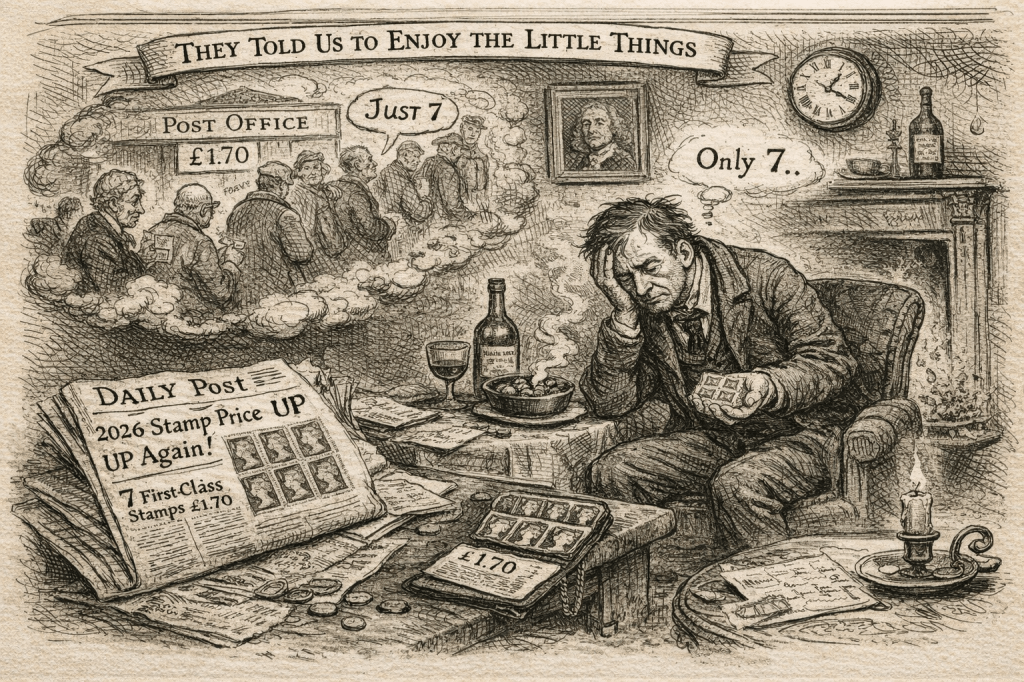
“I’d sit by the fireplace with a glass of Bordeaux,” Clive told me, “and balance several stamps in the palm of my hand. Just admiring them.”
He smiled faintly at the memory.
“I felt a sense of belonging.”
This was not a man who wanted yachts. Or sports cars. Or experiences marketed using the word curated. He wanted stamps. Little rectangles of paper that promised you could send something, somewhere, and trust it would arrive.
Now it’s 2026.
The cost of a first-class stamp is £1.70.
Clive still works at the same Tesco. He now earns £12.65 an hour. He said this part carefully, as if anticipating an argument from the universe.
“One hour’s work,” he said, “buys me seven stamps.”
Seven.
He stared at that number for a long time. Long enough that I wondered if it might change out of politeness.
“I can’t make that work,” he whispered.
Stamp prices, Clive explained, have risen 431%. His wages have gone up about 43%. He didn’t shout. He didn’t rage. He didn’t even seem particularly surprised. He just shook his head slowly, like someone watching a magician reveal the same card for the third time.
“I did everything right,” he said. “I didn’t speculate. I didn’t overreach. I chose a hobby that was sensible.”
He laughed once – a short, baffled sound.
“They told us to enjoy the little things.”
Now stamps feel extravagant. Reckless, even. Something he has to justify to himself. He stands in the Post Office, weighing up whether he really needs to send that letter, like a man considering a second mortgage.
“They were never an indulgence,” Clive said. “They were careful. Reasonable. They fit the world I thought I lived in.”
What Clive had lost, he explained, wasn’t just stamps. It was the values they represented. Fairness. Proportion. The idea that small pleasures would stay small. That if you loved something gently enough, it would be safe from economics.
“I didn’t want more,” he said. “I just wanted the same.”
He paused.
“I loved them,” Clive confessed. “And now I can’t afford to.”
That’s the cruelty of it. Not the money, exactly – but the quiet realisation that even the most modest joy can be priced out of reach. That even stamps, once symbols of connection and trust, can become luxury items.
The session ended. Clive put on his coat. Before he left, he turned back.
“Do you think,” he asked, hesitantly, “they’ll ever come back down?”
I didn’t have the heart to tell him the truth.
 Stories to Read...