I don’t usually take clients out into the world.
The world, in my professional experience, tends to ignore frameworks, resist reframing, and behave in ways that are deeply uncooperative with personal growth. It is much easier to coach a person in a controlled environment where the kettle works, the chairs are neutral, and no one is unexpectedly eating a sandwich three feet away.
But Arman requires what I have decided to call applied reality.
“Lunch,” I tell him, with the confidence of a man introducing a radical therapeutic intervention rather than a meal. “A public setting. Low stakes. Observational.”
He looks at me the way one might look at a man suggesting a casual stroll through a minefield.
“People will be there,” he says.
“Yes,” I reply. “That’s the point.”
He exhales slowly, already tired by the future.
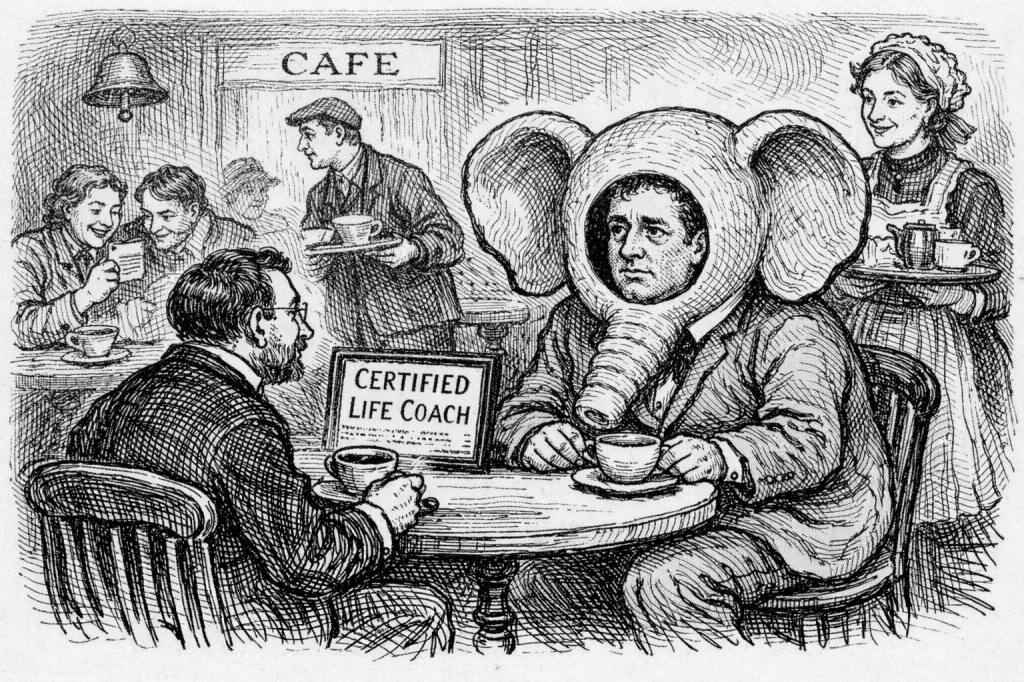
We choose a café that appears aggressively ordinary. The kind of place that serves soup with bread that is described as artisan but behaves like a sponge. A place where anonymity should thrive.
As we approach, Arman slows.
“They’ll see me,” he says.
“They’ll see a man entering a café,” I correct gently.
“They’ll look twice.”
“Some people look twice at everyone.”
“They’ll know.”
I open the door before the conversation can complete its familiar loop.
A bell rings. This, I immediately regret. It announces us.
Arman flinches.
Inside, there are people doing deeply unremarkable things: eating, scrolling, regretting their choices. No one turns. No one gasps. No one whispers, Edmond.
I consider this a promising start.
“Table for two?” asks the server.
Arman freezes, as if the question contains a trap.
“Yes,” I answer quickly, stepping in before he can confess to anything elephant-related.
We sit. Or rather, I sit. Arman lowers himself into the chair with the caution of someone expecting it to collapse into public recognition at any moment.
I carefully remove my framed certificate from my backpack and place it on the table, facing outward.
Arman doesn’t look at it.
“Okay,” I say, adopting my coaching voice, which is just my normal voice but slower. “Let’s observe.”
He is already observing. Intensely. Alarmingly.
At the table behind me, someone laughs.
Arman’s head snaps toward the sound.
“They know,” he whispers.
I turn, casually, professionally. Two people are looking at a phone.
“They’re watching a video,” I say.
“Yes,” he replies. “Of me.”
“Of something,” I correct. “Statistically unlikely to be you.”
“You didn’t see the screen.”
“Neither did you.”
He doesn’t like that.
A man walks past our table carrying a tray. His eyes flick briefly toward us in the way all human eyes flick toward movement.
Arman inhales sharply.
“There,” he says. “That look. That pause.”
“That was not a pause,” I say. “That was walking.”
“He slowed down.”
“He did not slow down.”
“He adjusted his speed.”
“He avoided spilling soup,” I counter.
Arman leans forward. “You’re rationalising.”
“I’m contextualising.”
The man with the soup leaves. No incident. No applause. No one points and says, There he is, the elephant with the human face.
I feel encouraged.
Arman does not.
The server returns. “What can I get you?”
Arman stares at her like she’s about to ask for an autograph.
“Just… coffee,” he says.
“Soup,” I add, because someone has to maintain structure.
As she walks away, Arman watches her.
“She recognised me,” he says.
“Based on what?”
“The way she looked at me.”
“She looked at you because you are the person ordering coffee.”
“No,” he says firmly. “There was a moment.”
“There is always a moment,” I say. “That is how eye contact works.”
He shakes his head, frustrated by my commitment to alternative explanations.
Around us, life continues with reckless indifference. A couple argues quietly about something unrelated to elephants. A man types aggressively on a laptop. Someone drops a spoon. It is, objectively, a complete absence of Edmond.
Arman grips the edge of the table.
“They’re being subtle,” he says.
“Who is they?”
“Everyone.”
“That’s a large coordination effort,” I point out.
He doesn’t appreciate the logistics.
Our coffee arrives. Arman doesn’t touch his.
The server smiles politely, the same smile she would give a chair if it ordered correctly, and leaves.
“There,” he says again. “That smile. She knows.”
“That was a service smile.”
“It was different.”
“How?”
He searches for it. “Knowing.”
I take a sip of my coffee. It tastes like something that once aspired to be beans.
“Arman,” I say, “let’s test something. Right now. In real time.”
He looks at me, wary.
“I’m going to stand up,” I continue, “walk to the counter, and ask the server directly if she recognises you.”
His eyes widen. “No.”
“Yes.”
“No!” he repeats, louder now. A few heads turn, not in recognition, but in mild annoyance.
He notices.
“There!” he hisses. “Now they’re all looking.”
“They’re looking because you raised your voice.”
“Or because they’ve finally placed me.”
I stand up anyway.
“Please don’t,” he says, panic rising into something sharper.
But I go. Because this is, in my professional opinion, a breakthrough opportunity.
I approach the counter. The server looks up.
“Hi,” I say, lowering my voice into what I hope is a conspiratorial tone. “Quick question, do you happen to recognise my friend over there?”
She glances briefly past me. Not a second look. Not even a first look, really. Just a directional acknowledgment of a human shape.
“No,” she says. “Should I?”
“No,” I reply. “That’s perfect. Thank you.”
I return to the table, carrying this victory like a small, fragile object.
“She doesn’t know you,” I say. “I asked.”
Arman stares at me.
“What did you say exactly?”
“I asked if she recognised you.”
“And she said no?”
“Yes.”
He leans back, processing this. For a moment, just a moment, I think we’ve done it. Applied reality has functioned. Evidence has been introduced. A narrative might shift.
Then he nods slowly.
“Of course she said no,” he says.
I blink. “What?”
“She wouldn’t admit it,” he explains. “Not in front of you.”
“Why not?”
“Professionalism,” he says. “Also… politeness.”
“Politeness prevents people from acknowledging elephant-related fame?”
“Yes.”
I open my mouth. Close it again. Open it once more, as if a better argument might be stored behind my teeth.
At the table behind us, the laughing people laugh again.
Arman flinches.
“They’re laughing at me,” he says.
“They’re laughing at their phone.”
“They’re pretending.”
“For what purpose?”
He gestures vaguely around the room. “This.”
“This what?”
“This whole… performance.”
I look around. Soup. Coffee. Mild disappointment. No stage lighting.
“This is not a performance,” I say.
He leans in, eyes intense, almost pleading now.
“You don’t understand,” he says. “It always feels like this before it happens.”
Before what?
But I don’t ask, because I’m not sure I want the answer.
Instead, I sit back in my chair, holding my cooling soup, surrounded by people who are profoundly uninterested in pink elephants, and a man who cannot escape one.
“Okay,” I say quietly, abandoning frameworks in favour of survival. “What would help right now?”
He doesn’t hesitate.
“Leaving.”
I nod.
For once, we agree on something.
We stand. No one stops us. No one whispers. No one even looks, not really.
The bell rings again as we exit.
Arman winces.
Outside, the street carries on, buses, footsteps, conversations that do not include him.
He scans every face anyway.
I make a mental note about applied reality.
It remains, for now, largely theoretical.
 Stories to Read...