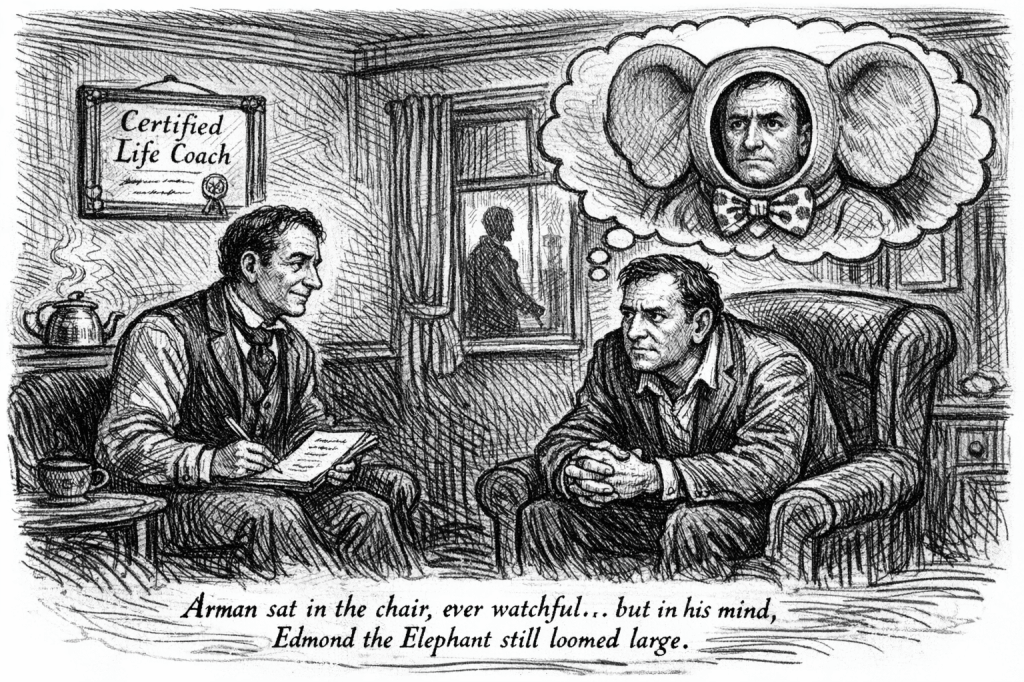
I make a point of introducing myself as a certified life coach before Arman even sits down, because in my experience the certification does most of the work. It hangs there on the wall behind me, framed, slightly crooked, like a quiet promise that whatever is wrong with a person can be reworded into something manageable.
Arman doesn’t look at it.
He stands in the doorway longer than necessary, scanning the room with the kind of suspicion usually reserved for border crossings and badly lit alleyways. Which, in a way, this is, just with softer furniture and a kettle.
“You’re safe here,” I say, in the tone that suggests I’ve said this many times before and believed it at least once.
He nods, but not in agreement. More like he’s acknowledging the attempt.
“Sit anywhere,” I add.
He chooses the chair that gives him the clearest view of both the door and the window. Years of suffering have trained him well. Armenia, as he described it to me when he first reached out, was less a country and more a stage he couldn’t step off. A place where anonymity was denied to him by a children’s television budget decision.
Edmond the Elephant.
Pink suit. Oversized ears. And, crucially, a circular cut-out where the face should have been, because someone, somewhere, decided that authenticity mattered in a man dressed as a cheerful elephant.
So Arman’s face, earnest, human, unmistakably his, became fused with Edmond. Not metaphorically. Literally. Children waved at him in the street. Parents pointed. Dates ended mid-meal when recognition dawned like a slow, devastating sunrise.
Years of this.
Years of being both a man and not a man.
“You’ve been in England one week,” I say, opening my notebook to a blank page I will not meaningfully use.
“Yes.”
“And how has that felt?”
He lets out a dry laugh. “Quieter,” he says. Then, after a beat: “But not quiet.”
I nod as if that distinction is profound rather than inevitable.
“Tell me what’s been happening.”
“They look at me,” he says immediately.
“Who does?”
“Everyone.”
There it is. A classic generalisation. Textbook. Very coachable.
“And what do you think they’re thinking?” I ask, already preparing a gentle reframing about cognitive distortions.
“That they know,” he says.
I pause, briefly inconvenienced by the sincerity of his answer.
“Arman,” I say carefully, “Edmond the Elephant is not… widely known in England.”
He studies me, as if I’ve just made a claim about gravity that he’s not entirely convinced by.
“You don’t know that,” he replies.
“I do, actually,” I say, with the confidence of a man whose expertise is largely decorative. “Different media markets. Different audiences. It’s very unlikely your work…”
“My face,” he interrupts.
Right. Not the work. The face.
I adjust. “It’s very unlikely your face has crossed borders in that way.”
He leans back slightly, but his eyes keep moving.
“In Armenia,” he says, “it didn’t matter where I went. Someone would always recognise me. Always. Even when I thought, maybe this time, maybe this place…” He shakes his head. “No.”
I make a note in my notebook. It says nothing useful. It might say “pattern???” or “face issue,” I’m not sure.
“But this isn’t Armenia,” I say, deploying what I consider to be a strong, geographical argument.
“No,” he agrees. “But people travel. People share things. Internet.”
Ah, the internet. The great equaliser of obscurity and fame.
“Have you had any direct experiences here?” I ask. “Anyone approaching you? Saying your name? Mentioning Edmond?”
“No,” he admits.
“Okay,” I say, seizing on this like it’s evidence in a trial. “So what we have is a feeling, not a confirmed reality.”
He smiles faintly. Not because he’s reassured, but because he’s heard this kind of sentence before, from people who have never worn a pink elephant suit with their own face exposed to the nation.
“You think I don’t know the difference?” he asks.
I hesitate. This is where the training manuals become less specific.
“I think your experiences in Armenia were… intense,” I say. “Years of constant recognition, lack of privacy, social consequences,especially in your personal life.”
“My personal life,” he repeats, almost amused. “You mean the part where women stopped seeing me as a man the moment they realised I was an elephant?”
“I mean the part where your identity was reduced,” I say, trying to sound like that’s what I meant all along.
He nods slowly. “Yes. Reduced.”
There’s a silence. Not the comfortable kind I was taught to allow, but the kind that makes me aware of the kettle clicking softly in the corner like it has something to add.
“So now,” I continue, pushing forward, “your mind is anticipating that same pattern here.”
“And you’re saying it’s wrong.”
“I’m saying it may not be accurate in this context.”
He considers that. Then shrugs, a small, defeated movement.
“Maybe,” he says. “But when someone looks at me… I don’t feel like I’m in England.” He taps his temple. “I feel like I’m back there. On the street. In the restaurant. Waiting for it.”
“For what?”
“For the moment they stop seeing me,” he says. “And start seeing him.”
Edmond. Uninvited, but never absent.
I glance, briefly, at my certificate. It offers no guidance.
“We can work on grounding techniques,” I suggest. “Reality testing. Gradual exposure to social situations where…”
“You keep saying reality,” he interrupts again, though not unkindly. “But my reality was years of this. Not one moment. Not one mistake. Years.”
I nod, because that is, inconveniently, true.
Outside, someone walks past the window. Arman’s eyes flick toward them instantly, tracking, measuring, bracing. The person doesn’t look in. They just pass.
He doesn’t relax.
“You’re safe here,” I repeat, softer this time, and less certain of what I mean by here.
He nods again, the same non-agreement as before.
We sit like that for a while: a man who cannot stop being seen, and a man who is professionally obligated to believe that seeing can be managed.
I make another note in my notebook. It looks more official this time, but says even less.
Somewhere in Armenia, Edmond the Elephant is probably still smiling.
And here in England, Arman watches the door.
 Stories to Read...