
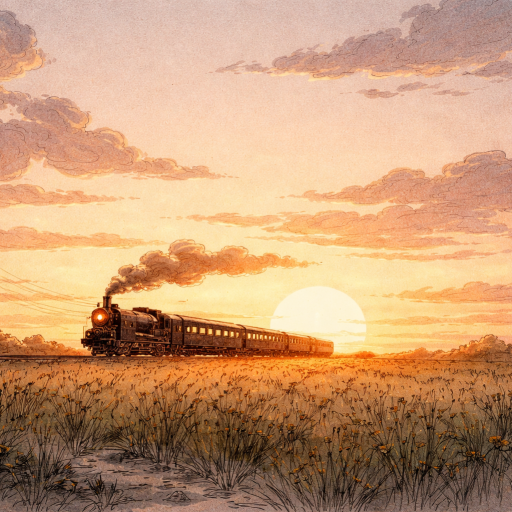

There is a village where the fast train does not so much pass through as dismiss. If you are travelling from the coast to London and you blink, you will miss it – a smudge of hedgerow and chimney smoke somewhere south of Canterbury, gone before you’ve finished your sentence. But miss your connection, take the stopping service instead, and the train will slow, sigh, and hold itself at a small unmanned platform for exactly one minute. A sign, in peeling green paint, will tell you that you have arrived at Feothan.
You would have no reason to get off. Nothing in the soft, indifferent hills suggests that you are looking at the site of the longest-running war in Western Europe, a conflict that has, with grim quietness, outlasted the Hundred Years’ War by several decades and shows no sign of the good manners to end. I would not recommend it. But if you are curious, or unlucky, let me tell you how it started.
Martha Wilson kept the tea urn of Feothan the way other women might have kept a shop, or a secret. She was neither young nor old, the kind of woman who seemed to have always been forty-five, with flour-dusted forearms, a laugh that carried across two gardens, and a diary she guarded with the seriousness of a general’s map table. Every fete, funeral, wedding and whist drive in the parish ran, in the end, through Martha and her enormous brown pot.
It was a Tuesday in early autumn – the kind of soft gold afternoon that makes a village look freshly painted – when the diary betrayed her. The church, on the western slope, had booked her for three o’clock. So, unbeknownst to either party, had the village hall, on the eastern side, for the very same hour.
Martha, sensibly, went to the hall first, since it was closer, and spent a contented afternoon pouring for the reading society, entirely unaware that across the green, seven members of the church flower committee were standing in a kitchen that smelled of nothing but their own bewilderment, waiting for a kettle that was not going to be filled by anyone but themselves.
She discovered her crime on the walk home. Mrs. Pargeter and five others were arranged outside the church porch like a firing squad in cardigans. “We wondered,” Mrs. Pargeter said, in the particular tone reserved by Englishwomen for wondering aloud about the collapse of civilisation, “where you’d got to.” Before Martha could open her mouth to explain, they had turned as one and gone back inside, leaving her standing in the lane with the late sun in her eyes and a slow, mortifying understanding spreading through her chest.
She took to her bed for four days. She told the neighbours it was a chill. It was not a chill.
On the fifth day, Martha Wilson did something that would echo through the next century of her family’s life, though she had no way of knowing it at the time. She got up, dressed properly for the first time in days, and walked with great purpose to the village hall noticeboard, where a large ordnance map of the parish hung slightly crooked in its frame, curling at the corners from decades of damp.
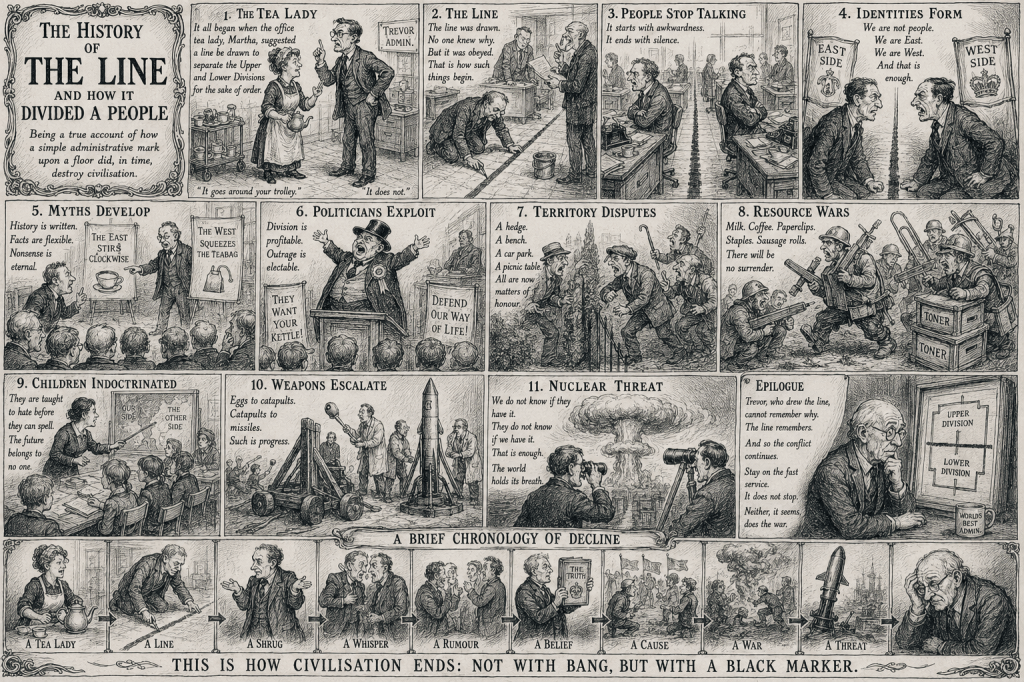
She took the stub of a pencil from the string beside it, found the church spire at the top and the hall roof at the bottom, and drew a single firm line between them, straight down the middle of Feothan, dividing it as cleanly as a wedding cake.
Village hall, Monday to Thursday. Church, Friday to Sunday.
At the AGM the following evening, held in a hall that smelled of instant coffee and damp coats, the proposal was met with the warm, relieved nodding of a parish that dearly wanted the matter closed. Martha sat very straight in her chair and did not smile, though everyone could see how much she wanted to.
Nobody thought to ask what would happen to all the ordinary, unscheduled moments in between.
The trouble arrived, as trouble so often does, disguised as good manners.
Dillon Baker, a wiry young man who mended fences for a living and gossip for pleasure, happened to be walking past the church one Tuesday, a hall day, and thought he might pop in and see how Martha was getting on. He found her at the trestle table, pouring, and stopped in the doorway with the peculiar, prickling sense that he had interrupted something he wasn’t meant to see. Martha, for her part, felt a hot flush of panic. Had she double-booked again, and served him his tea with such rigid correctness that Dillon left without finishing it?
He mentioned it, later, to his wife, in the tone one uses to describe something faintly indecent. She mentioned it to her sister. Within a fortnight, half the village had quietly absorbed the idea that visiting the wrong building on the wrong day was, if not exactly a sin, then certainly not quite right.
People stopped calling in on old friends across the green without checking, first, which day of the week it was. Doorsteps that had once been crossed freely began to feel, subtly, like thresholds. Nobody announced a boundary. Nobody needed to. It simply became easier, and then habitual, and then unremarkable, to stay on one’s own side of the line Martha Wilson had drawn.
By the time the children who had watched this happen had children of their own, nobody in Feothan could have told you, with any real confidence, what an East-sider was. They could, however, tell you at extraordinary length what an East-sider was not, and vice versa, with mirror-image fluency, on the western slope.
Identity, having lost its content, filled the vacancy with opposition. To be from the West was, increasingly, simply to be not East: not loud in that particular East-side way, not careless with hedges in that particular East-side way, not, though nobody could quite articulate why, trustworthy in the specific manner East-siders were held to be untrustworthy. The East returned the compliment with interest. Two communities that had, within living memory, shared a cricket team now defined themselves almost entirely by the shape of the hole where the other half used to be.
Suspicion, once it has nowhere further to travel sideways, tends to travel downward. What began as different hardened, gradually, into lesser, and from there into something colder still. Small transgressions, a boundary hedge left untrimmed, a dog that strayed, a delivery boy who took the long way round, were no longer read as the ordinary friction of village life. They were read as evidence. Each side came to hold, with the calm certainty of people discussing the weather, that the other side contained something the Bible might once have called sin, and now simply called them.
It was, perhaps, inevitable that God would be recruited.
Two rival congregations grew from the one church that had split down Martha’s pencil line, identical in liturgy, identical in hymn book, differing from one another by exactly one disputed clause of interpretation, over which each was prepared to be utterly intransigent. The Western Fellowship held, with theological confidence bordering on delight, that the forbidden fruit of Eden had unmistakably been red. The Eastern Reformed held, with equal certainty, that it had been green.
From this single point of doctrine grew an entire minor religion of abstinence and ritual insult. Old Mrs. Bream, on the western side, kept a bowl of red apples on her sideboard purely so she could tut at them before dinner. Across the hedge, young Kieran Hobbs made a small performance of muttering “wicked thing” at every green apple before biting into it, a habit his mother found unbearably twee and his friends found unbearably normal, because it was simply how things were done.
Every war eventually produces the man who cannot fix the drains but discovers he can, with very little effort, fix the blame. In Feothan, several such men arrived over the decades, a councillor here, a lay preacher there, each finding that a village frightened of its neighbours will forgive almost any failure of competence in a leader who promises, convincingly, to hate the right people on their behalf. It cost these men nothing. It cost the village, in the fullness of time, almost everything.
By the time the first fence went up across what had been common grazing land, nobody could quite remember whose idea it had been, only that it seemed, by then, entirely necessary. Land that had passed between neighbours for generations was suddenly ours and theirs, and men who had shared tools their whole lives began sharpening different ones.
It was on a warm July evening that the first real violence broke out, not over land at all, in the end, but over sausage rolls. A police patrol, passing through on a routine visit, stopped at the bakery on the East side for a bag of Maggie Stoddard’s finest. Word reached the West by the time the officers had finished eating. By nightfall, Tony Gower’s milk float had been overturned in the lane, cheese parcels were sailing over the hedge in both directions, and a pub that had stood since the reign of George III was burning quietly against the dusk. The vicar, watching from the churchyard wall, later said it was the first time he had heard the whole village shouting the same three words, though not, of course, at each other, but past each other, over the hedge, into the dark.
Once land had become territory, supply became a weapon almost without anyone deciding it should be. Teabags, sugar and milk stopped reaching the co-op from the West; the East, in turn, found the road to the post office quietly and unofficially closed. Both sides told themselves, with straight faces, that this was simply prudent self-defence. Both sides, within a season, were drinking their tea black and resenting it bitterly, a fact that struck nobody as absurd, though it should have struck everybody.
The war’s cruellest achievement was patience. It did not need to win quickly, because it had learned to reproduce itself. Children on both sides of the hedge grew up knowing which side they belonged to before they could tie their own shoelaces, taught, gently, lovingly, by parents who believed absolutely that they were protecting them, exactly whom to distrust and exactly what they were defending. Ann Wilson, Martha’s great-great-granddaughter, was one of these children, and grew, despite it, into a woman who still crossed the line herself, twice a day, with a teapot, as though daring the hedge to mean what everyone said it meant.
The arsenal grew the way these things do, not all at once, but by small, almost reasonable increments, each one justified by the last.
It began with pitchforks, snatched up in the heat of an argument and rarely used for more than posturing. Then came the Tractor Wars, three terrible weeks during which the fields on both sides were churned to mud by machines never designed for combat, and during which, in a detail the vicar still cannot repeat without his voice catching, the long-forgotten, unmarked grave of Martha Wilson herself was flattened beneath a Massey Ferguson, the woman who had drawn the line undone, at last, by the line itself. Shotguns followed, kept “for the rabbits” by men who had never once, in living memory, shot a rabbit. And now, in low voices, over garden fences that are no longer crossed, there is talk, unconfirmed, unofficial, never quite denied, that each side has acquired something considerably worse, stored somewhere between the allotments and the bus shelter, waiting.
Ann Wilson still keeps the rota. She still crosses the hedge most days, teapot in hand, insisting, against a century of evidence to the contrary, that tea saves lives. She may be the only person left in Feothan still trying something that hasn’t already failed.
So if you are ever changing trains south of Canterbury and see the stopping service to London easing into the platform beside you, I would recommend, gently, that you stay exactly where you are. Let it leave without you noticing, twenty-three minutes past the hour, if you’re curious, though I hope you won’t be.
You will save yourself a great deal of trouble. And you will never have to explain to anyone why you were standing on the wrong side of a hedge at teatime.


Leave a Reply