

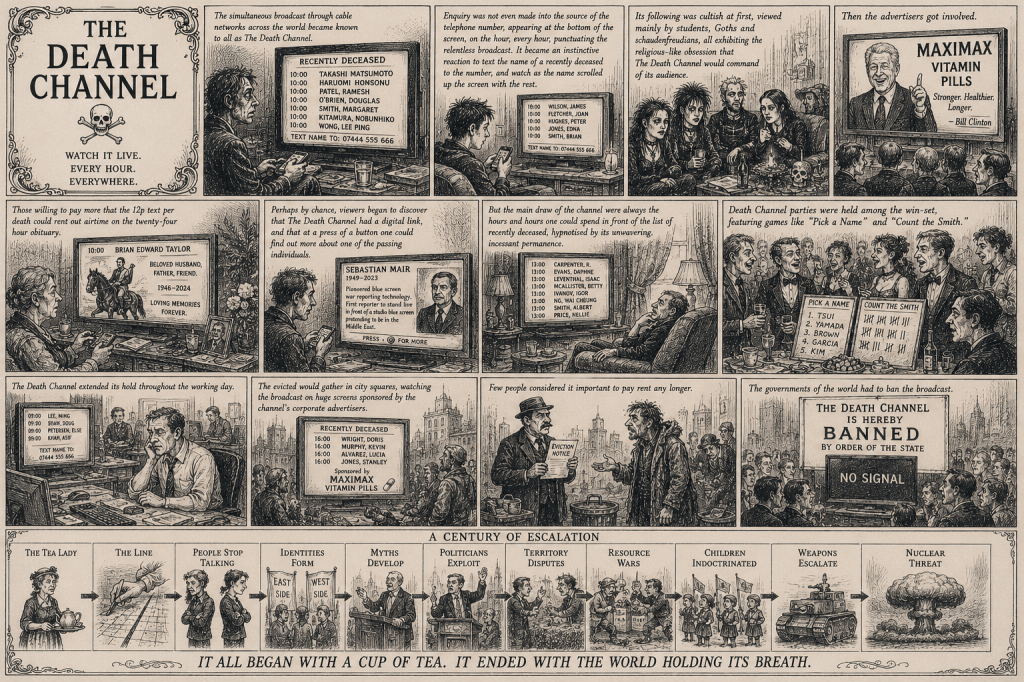
Nobody knows how it started: an endless list of names, white text on a black background, scrolling ever upward on our television screens. It’s impossible to tell who first deciphered the steady list as being the names of those just departed, or where and when the simultaneous broadcast through cable networks across the world became known to all as The Death Channel. Enquiry was not even made into the source of the telephone number, appearing at the bottom of the screen, on the hour, every hour, punctuating the relentless broadcast. It became an instinctive reaction to text the name of a recently deceased to the number, and watch as the name scrolled up the screen with the rest. The origins of the phenomena were never questioned. The Death Channel was accepted as ever having existed, an overlooked permanence, now developed into a global obsession.
Its following was cultish at first, viewed mainly by students, Goths and schaudenfreudians, all exhibiting the religious-like obsession that The Death Channel would command of its audience. These were joined by the curious, the literary, and those who had already seen everything on all the other channels twice. All other broadcasts, no matter how bloody, loud or explicit seemed an irrelevance to the masses now joining the sprawling audience of The D.C, democratic in spanning ages, cultures and continents with its mesmerising hold.
Death Channel parties were held among the win-set, featuring games like “Pick a Name” and “Count the Smith,” patriotically embracing a break in the mind numbing Takashi Matsumotos, the Haruomi Honsonus, and the imperialistic Patels. But mostly, people watched alone, in their billions.
Then the advertisers got involved. The world exhaled a collective gasp when the list of assenting souls was interrupted by the proud face of ex-President Bill Clinton, extolling the virtues of MaxiMax Vitamin Pills. Demand for the placebo pills was so great the following morning that supermarkets had to lock their doors to desperate customers. MaxiMax adverts were joined by those for funeral homes, grass diets and Fit Force Gymnasiums. Fit Force began to screen video tapings of The Death Channel on the TVs above its treadmills. The Death Channel’s global viewing figures overtook those for reruns of “Friends.”
Those willing to pay more that the 12p text per death could rent out airtime on the twenty-four hour obituary. Some time during the broadcast, the death call would be punctuated by a short piece of home video footage: the recently departed poncing around on a horse at the manor, or at a family barbeque in the suburbs, or playing with the kids. A few of the eccentric rich sent home-made digital documentaries, detailing the importance of their lives, along with the instruction to broadcast at the time of their death and a huge airtime rental fee.
Perhaps by chance, viewers began to discover that The Death Channel had a digital link, and that at a press of a button one could find out more about one of the passing individuals. Most were a disappointment, the likes of Nobunhiko Kitamura – Welder/Cancer, but occasionally one would find a Sebastian Mair, who not only pioneered blue screen war reporting technology, but also was “the first reporter to stand live in front of a studio blue screen pretending to be in the Middle East/Old Age.”
But the main draw of the channel were always the hours and hours one could spend in front of the list of recently deceased, hypnotised by its unwavering, incessant permanence. One would begin to look for the names of long since lost friends, or lovers, and become lost in reminiscence of life experienced, reinteracting with ghosts of a past once lived, and then returned to the present day, disorientated, but in some way satisfied.
The Death Channel extended its hold throughout the working day. People stayed at home, sighing to themselves as complete strangers scrolled past, offering occasional sympathies like “old Doug Shaw’s gone,” shaking their heads in respect. Few people considered it important to pay rent any longer. The evicted would gather in city squares, watching the broadcast on huge screens sponsored by the channel’s corporate advertisers. But nobody felt it necessary to buy anything anymore, and unless the corporation produced some widely circulated protein shake, they soon crumbled beneath their oblivious personnel. The governments of the world had to ban the broadcast, and despite initial shock and a sigh of protest, things drifted back to the way they had been, and The Death Channel became a distant memory.


Leave a Reply