

Chapter 12
Pronouns
The following is one the more compelling extracts from the forthcoming work by renowned linguist/librarian, Brian Butler Sloss, ‘Understanding Grammar,” to be published by Ogariv Press later this year.
Presenting, Chapter Twelve, ‘Pronouns’.
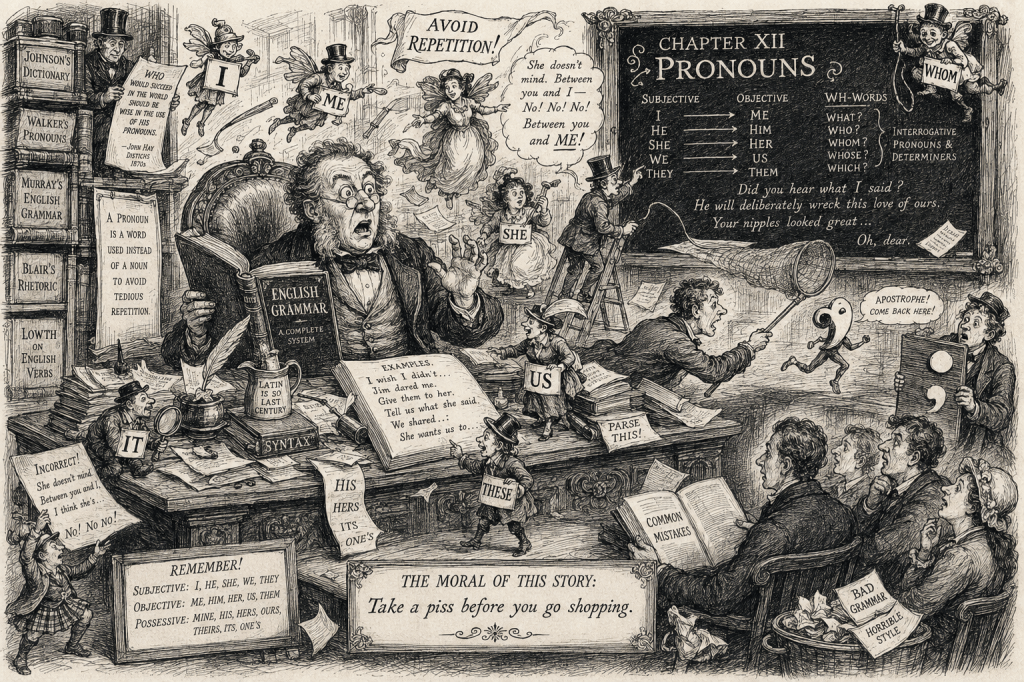
“Who would succeed in the world should be wise in the use of his pronouns.” John Hay Distichs, 1870s
Disclaimer: The guidance given here is based on British Standard English, the form of English that has become established as the form of use in education, communications, and officialdom.
Pronouns
A pronoun is a word such as I, me, you, he, she, it, they, them, ourselves, this, those, and so on, which refers to a person or thing already known. Pronouns are used to avoid repeating nouns (as you would in a sentence such as Brian finds it difficult to socialize and Brian has few acquaintances).
The subjective form is used when the pronoun is the subject of a verb, and the objective form is used when it is the object (direct or indirect) of a verb:
I wish I didn’t spend all day working in a library.
She entered wearing black fish-net stockings and a tight, leather mini-skirt.
Jim dared me.
Give them to her; it’s only Chaucer.
I met her after work.
Tell us what she said.
Pronouns change their form in the plural, and are wonderful:
We shared a motorbike. She took the front, and insisted I “ride bitch.”
She wants us to become registered Pagans, and to drink blood under the moon.
And so on.
Between you and I, and similar mistakes
Incorrect: She doesn’t mind. In fact, between you and I (me), I think she’s quite attracted to my inexperience.
Incorrect: Apparently, there used to be a thing between she (her) and the leader of the Hell’s Angels. I wish she’d quit and get a proper job.
The mistake is obvious, but can be forgiven even when made by the most respected of erudite linguists after a night of heavy intoxication and joy-riding
Indeed, confusion of me and I can trouble us all.
She wants me to start wearing contact lenses, and to stop speaking in a so called girly-voice.
and not:
She wants I to move out of mother’s house, and to try my hand at adulthood.
Plus vague statements and misinterpretations.
Adverbial modernizations are becoming more common on tattoos such as:
luv u 4 eva.
While this is grammatically abhorrent and stings like hell, it is a lasting display of loyalty and gratitude to the “u” in question, and so sometimes you’ve got to just chill and go with it.
I mean, what’s with all these rules, and don’t do this, and don’t not do that, anyway? It’s all so double negative.
Wh– words: interrogative pronouns and determiners.
Let’s bypass colloquial niceties and self deception and get straight to the point:
pronoun What is that smell?
determiner What were you doing with the massage oil?
pronoun Who was that?
pronoun Whom else are you seeing?
determiner Whose car is that outside?
pronoun Whose is this lubricant?
They are also used in so-called indirect questions:
pronoun Did you hear what I said?
Pronouns are also used to denote ownership in a more emphatic way:
He will deliberately wreck this love of ours.
I will rid our lives of this menace.
and most importantly, in revelation:
Your nipples looked great with piercings and now I’ve got mine done, too!
Be careful not to misuse pronouns in the formulation of desperate, invalid excuses.
His (He is) just a friend.
It is a serious mistake because many people regard this as a sign of illiteracy, and not just as the fact that you are hiding something.
As demonstrative pronouns, This and That are used to specify a person or thing already mentioned.
That is not what people usually hire me to do at all.
This is just like hunting rabbits.
This and That can also refer to facts and statements expressed earlier in the sentence:
She has insulted my intelligence and I can not allow her to live after that.
The plural forms these and those have the same general (and often vague) distinction:
Could you accept these as further payment?
Those are limited edition Beatrix Potter!
A word of caution: overuse of personal pronouns can be a liability:
To think, I left my parent’s home to be with you!
You’re forty-seven years old!
These and Those. Choice between the plural forms of these and those, these implying familiarity and moistness, those implying dry remoteness. Both betray a momentary lapse into weakness:
I must draw attention to those places that have given me special pleasure.
You will never visit those places again with that little willy wiggler of yours.
Here are some 3rd person singular pronouns: hers, his, its, one’s.
The only one of these words to have an apostrophe is one’s. This is because one is not strictly speaking a pronoun at all, but a curse of state to which some must be condemned, and so it forms a possessive, like other nouns, in irony, for what do we truly “have?” eg.
Rifle’s shot, Valerie’s head.
Is none singular or plural?
There are people who insist that none is a singular pronoun and must therefore always be followed by a singular verb:
None of the police was able to identify the killer.
But a plural verb is also possible:
None of the police were able to identify the killer.
Final word:
Some may argue that all pronouns can be abbreviated:
I hate pedestrians. I hate ‘em. I hate ‘em all. I’d never go near any of ‘em.
Avoid these people. They are trouble, as is the phrase.
I should have never strayed from behind my cozy library desk.
which splits the infinitive, and should be reworded as:
Jim has lost the file-cards, the file-cards, the file-cards; Jim has lost the file-cards: make him leave the gang.
 Stories to Read...
Leave a comment