

She arrived fifteen minutes early and still managed to look as though she had been waiting for years.
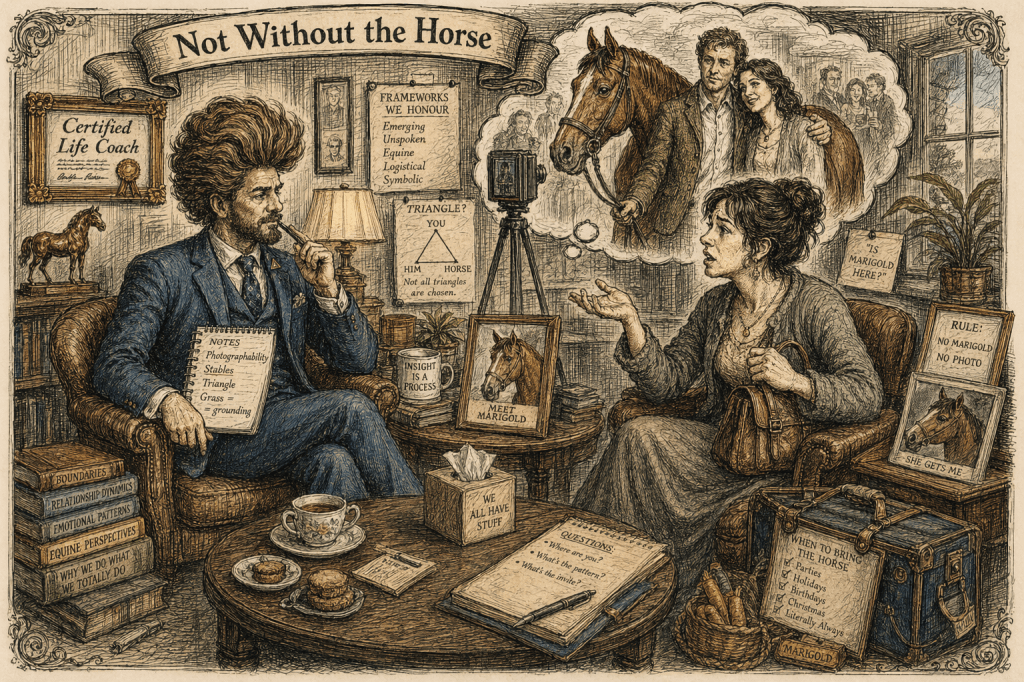
I gestured toward the chair opposite me, soft lighting carefully arranged to suggest both calm and insight. She sat, clutching her bag in a way that implied either emotional fragility or the presence of snacks. I made a note to explore that later, if time allowed.
“Take your time,” I said, in the tone I reserve for moments that might become meaningful.
She didn’t take her time.
“My boyfriend won’t be photographed unless his horse is in the picture.”
I nodded, slowly, as if this were a sentence that simply needed air around it.
“Of course,” I said.
She blinked. “Of course?”
“Well,” I replied, leaning back slightly, “it’s important not to pathologize too quickly.”
There was a pause. A long one. She seemed to be waiting for me to continue. I did not.
Eventually, she filled the space.
“It wasn’t always like this,” she said. “When we first met, he was… normal. I mean, not normal – no one’s normal – but photographable. Completely photographable.”
I wrote that down: initial photographability present.
“We met at a friend’s birthday,” she continued. “Someone took a picture of us in the kitchen. He didn’t even hesitate. Arm around me, smiling. Teeth and everything.”
I nodded again, encouragingly.
“And then, about two years ago, he started volunteering at a stables.”
I underlined stables in my notebook. There was something there.
“At first it was sweet,” she said. “He’d send me pictures of this horse – a beautiful brown colour, chestnut. Her name’s Marigold. He’d say things like, ‘She gets me,’ which… fine. People say that about pets.”
“Mm,” I said, in a way that could mean anything.
“But then one day,” she went on, “we were at my sister’s engagement party, and someone asked to take a photo of us. And he said – just casually – ‘Not without Marigold.’”
I tilted my head.
“At the time, we laughed. We thought he was joking. My sister said, ‘Well, unless she’s parked outside, I think we’ll manage.’ But he didn’t laugh. He just stood there. Not angry. Not upset. Just… unavailable.”
I wrote: boundary introduced (equine).
“So we didn’t take the photo,” she said. “It felt awkward to push it.”
“Of course,” I murmured. “We must always honour emerging… frameworks.”
She stared at me briefly, then continued.
“After that, it became a thing. At first, it was just parties. Then holidays. Then just… everything. If there was a camera, he’d ask, ‘Is Marigold here?’ And if the answer was no, he’d step aside. Or offer to take the picture instead. He’s in none of my photos from the last eighteen months.”
I nodded gravely. This was clearly a progression.
“Have you met Marigold?” I asked.
“Yes,” she said. “Several times. She’s a horse.”
I jotted that down as well, for completeness.
“She’s perfectly nice,” the woman added. “But she doesn’t live with us. She doesn’t attend events. She doesn’t have a phone. Coordinating her presence is… not practical.”
“Mmm,” I said. “Logistics can be revealing.”
She leaned forward slightly. “Last Christmas, he suggested we bring her into my parents’ living room. Just briefly. For a photo.”
I paused my pen mid-air. “And how did that land for you?”
“My parents have cream carpets,” she said.
I nodded, slowly, as if this were a profound statement about values.
“And the worst part,” she went on, “is that he doesn’t see it as a problem. To him, it’s just… how things are. He says photos feel ‘incomplete’ without her. That they don’t ‘represent his truth.’”
I circled truth in my notes. Always a useful word.
“So now,” she said, her voice tightening slightly, “I have all these moments -birthdays, trips, dinners – and he’s just… not in them. It’s like I’m dating someone who refuses to exist visually unless accompanied by livestock.”
I let the silence sit between us, rich with potential.
Finally, I spoke.
“What do you think the horse represents?”
She frowned. “I – what?”
“The horse,” I repeated gently. “What might it symbolise for him? Strength? Freedom? A resistance to being seen alone?”
She considered this. “I think it’s just a horse.”
I nodded, as if this, too, were valid.
“Have you tried,” I said carefully, “taking photos from the horse’s perspective?”
She blinked again. This was becoming a pattern.
“I don’t… know what that means.”
“Sometimes,” I explained, “when we shift perspective, we uncover new layers. For example, if Marigold were holding the camera – metaphorically – what might she capture?”
“Grass?” she suggested.
“Interesting,” I said, writing it down. grass = grounding.
She sat back, clearly reassessing her decision to come here.
“I just want to know what to do,” she said. “Do I accept this? Do I push back? Do I… bring the horse everywhere?”
“Ah,” I said, steepling my fingers. “Options.”
We sat with that for a while.
“Let me ask you this,” I continued. “Where, in this dynamic, are you located?”
She looked at me. “I’m… right here.”
“Yes,” I said, nodding. “But also – where are you, energetically, in relation to the horse?”
“I’m not in relation to the horse,” she said. “I’m in a relationship with a man who won’t take pictures without one.”
“Mm,” I replied. “So there’s a triangle.”
“There doesn’t need to be a triangle.”
“Not all triangles are chosen,” I said softly.
She rubbed her temples.
“Have you expressed how this makes you feel?” I asked.
“Yes,” she said. “Many times. He listens. He nods. And then the next time there’s a camera, he says, ‘Is Marigold here?’”
I wrote: consistency present.
“And what happens in you, in that moment?” I asked.
“I feel ridiculous,” she said. “And invisible. And like I’m arguing with a rule that shouldn’t exist.”
“Powerful,” I said. “Very powerful.”
She looked at me, hopeful for a brief, dangerous second.
“So what do I do?” she asked.
I took a breath, allowing the weight of the moment to settle.
“Sometimes,” I said slowly, “when faced with a boundary we don’t understand, the invitation is not to change it… but to notice what it brings up in us.”
She stared at me.
“So I just… notice?” she said.
“Notice,” I confirmed.
“And then?”
“Continue noticing,” I said.
There was a long pause.
“I could have stayed home,” she said quietly.
“Yes,” I agreed. “And yet, here you are.”
We sat together in that, which I felt was, in its own way, a kind of progress.
As she gathered her things to leave, I offered one final thought.
“If it resonates,” I said, “you might try journaling as the horse.”
She nodded faintly, the way one does when there is no polite alternative.
After she left, I looked down at my notes.
Photographability.
Stables.
Triangle.
Grass.
I closed the notebook, satisfied that something meaningful had, undeniably, been explored.


Leave a Reply